Showing posts with label orconf. Show all posts

Monday, December 22, 2025

FOSSi Fiesta 2024


 It's time again to do one of those yearly retrospectives. Am I early being unusally early this year since the year hasn't even ended yet? Actually.... this one is for 2024. I was supposed to to it in January but...well... life happened. Anyway, this should be fine, right? It's still 2025 so it's still a retrospective of last year. Aiming to keep this one a bit shorter to release it before the bells ring.

SERV

2024 was an action-packed year for the award-winning SERV, the world's smallest RISC-V CPU. A new version, 1.3, was released, and thanks to a collaboration with Harvard and Pragmatic Semiconductors, SERV became the first ever fully programmable general purpose CPU implemented on printed electronics. The resulting article was published in Nature and can be found here.

Being published in Nature is nice and all, but you really know you made it when your Nature article is picked up by PC Gamer


 The first steps were also taken this year to make wider and faster versions of SERV called QERV and HERV which was presented as a fancy poster at the European RISC-V Summit in Munich.

Extra proud of the little pockets for holding stickers at the bottom of the poster


During Latch-Up at MIT in Cambridge (which is totally not Boston), I also did the first-ever presentation of the SERV-based benchmarking project CoreScore as a lightning talk. I also had the luck to win a slot on the seventh TinyTapeout....tapeout which I used as an opportunity to create Underserved, yet another SERV-based SoC with even tighter resource requirements than usual.

FuseSoC & Edalize

Both FuseSoC and Edalize saw massive improvements over 2024. At Latch-Up in Cambridge (which is definitely not Boston) I did the first-ever dedicated presentation on Edalize, rather than sneaking it in as a part of a FuseSoC presentation. There was definitely enough things to talk about to fill a whole presentation. The new Flow API is shaping up nicely and more tool backends and flows are being ported over from the legacy API. There's also a whole bunch of things in the work that I won't bore you with here. Just watch the video instead. It's probably still boring but at least it's moving pictures instead of text which I hear all the kids prefer today.

I did a presentation of FuseSoC during ORConf, called the future of FuseSoC, some of which is now the past of FuseSoC and present of FuseSoC since we now live in the future relative to when the presentation was made. ORConf this year was a bit special since it was held in my old hometown and my old university. Amazing that they still let me in there, come to think of it. As always, ORConf was a lot of fun and an opportunity to meet old and new friends and learn about things.

Color-coordinated FOSSi fashionistas

So, was that all that happened in 2024? Not really, but as I mentioned initially, it's already slightly delayed so let's stop here. And you know what? Why don't you tell me what I missed? Happy to make updates. Still got nine days to go. Have a great 2025. I'm sure it can't be worse than 2024.

Saturday, June 15, 2024

FOSSi Freakout 2023


So, this was supposed to be one of those new year retrospectives. It's just that I didn't really find time to write this until now. Still closer to last new year than the next one, so I think it's ok. As usual, this is a round-up of all free and open source silicon, or FOSSi, things I have been involved in over the past year.

FOSSi Foundation

Beatiful evening in Santa Barbara. What is not seen in the picture is that everyone spent the rest of the evening trying to get rid of tar from their feet


This was the year when we resumed our on-site conferences after doing our virtual FOSSi Dial-Up series for a few years. We did Latch-Up in Santa Barbara and ORconf in Munich, and both events were great successes. Hope to see you all at our future events. Fellow FOSSi Foundation director Philipp Wagner also did a well-received open source chip design talk at the FOSDEM main track.

SERV

The award-winning SERV, the world's smallest RISC-V CPU turned five years old, which I wrote about in a retrospective called Five years of SERVing for its fifth birthday. It was also the year when SERV got its big sister, QERV, which provides a 3x speed-up for a marginal extra cost in area. Most of the work was done by a colleague at Qamcom and we did a press release called Qamcom boosts RISC-V which has more details. QERV currently lives in a separate repository, but the ultimate goal is to integrate it into SERV with a switch to select width.

There's also an ever bigger version called HERV on its way. A lot more things has happened with SERV but I'm saving that for the next SERV release announcement. Some of the news were also revealed in the talks I did about SERV at FPL (not recorded), ORConf and the Göteborg RISC-V Meetup (not recorded).

FuseSoC

A tour through FuseSoC and Edalize


FuseSoC saw a lot of activity in 2023. We finally got version 2.0 out of the door and with that we could remove a lot of old code and focus on new features such as core file validation, supporting the use of FuseSoC as a library instead of a stand-alone application, cached generators, file tags, minimizing rebuilding and other things that you can read about in the FuseSoC documentation. I also managed to three FuseSoC presentations; at FPL (not recorded), ORConf and the CHIPS Alliance Technology Update.

VeeRWolf

During 2023 I found some time to work on VeeRwolf...wait, did you say VeeRwolf? I thought it was called SweRVolf. Yes, one of the bigger changes was a complete renaming from SweRVolf to VeeRwolf, since the SweRV cores were renamed VeeR. Anyway, apart from the renaming, the Zephyr BSP for VeeRwolf was upgraded to support Zephyr 3.5 instead of the old 2.7 thanks to one of my Qamcom colleagues. As regular readers probably know already, VeeRwolf is the base for the RVFPGA computer architecture programme, and over the year I had the pleasure of participating in two different RVFPGA workshops and meet the other RVFPGA team members.

Edalize


The big new things for Edalize the past year was the introduction of the Flow API. I have written about this specifically a few times before,  but to sum it up, it's a complete revamp of how the Edalize backends work that enables new workflows, avoids code duplication, allows for external plugins, avoid unnecessary rebuilds and a lot more good things. As with all new feature introductions, some effort was spent hunting down newly introduced bugs but the code is now in a good shape. I'm using the flow API with Cocotb-enabled simulations as my daily driver now and it works great. It would still be great to get some help porting over all the old backends to the new API.

Speaking of backends, Edalize got several new ones in 2023, namely sandpiper-saas, openroad, design compiler, genus and efinity

Also the documentation saw a lot of improvements.

CoreScore


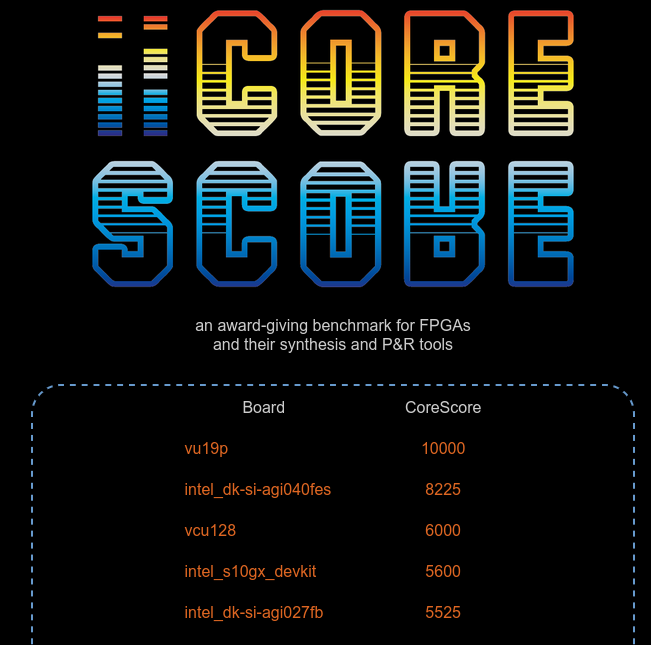
The CoreScore project did not see any new records. 10000 cores in an FPGA is still at the number one. We did howver see support for some new boards with Intel snatching three of the top five spots with their new Agilex devices and the introductions of new FPGA vendor Efinix and their Xyloni board.

LED to Believe

I tried to push for project LED to Believe to support 100 different FPGA boards by the end of the year. We got reeeeally close, but the big celebration came after the year had ended.  Still there was a healthy number of newly supported boards over the year.

Other

In an attempt to collect all videos of my FOSSi projects, I made a video gallery. After that experience I decided not to add web design to my CV.

As I have started using Cocotb more and more, I thought it would be a good idea to also have a quick example of how to use FuseSoC and Cocotb together, so I made an example design called fusesocotb to serve as a reference design.

This very blog also celebrated since 2023 was the year that saw the 100000th visitor to the site, much thanks to a UVM vs Cocotb post that went viral in late 2022.

And that pretty much sums up my 2023 FOSSi activities. Well, not quite. I won an award also. At the RISC-V Summit I was awarded a Community Contributor award. I was really happy to receive that and to hear that the open source contributions I do are actually acknowledged and appreciated. So, big thanks for that. And thanks also to the RISC-V summit organizers for making it easy to find my seat.


Monday, August 21, 2017

OSDDI: Director's commentaries

Andrew Back of AB Open and FOSSi Foundation has been working on this great series of interviews called Open Source Digital Design Insights, in which he has been interviewing some of the great minds of the Free and Open Source Silicon movement (+ me). In the fourth episode the turn has come to me. As I watch the video myself, I realize how quickly time moves in the open source silicon world and how many things that have happened since then. I would therefore like to take the opportunity to add some more context as an addendum to the interview.
The interview was made at ORConf 2015, the same day as we publicly announced the Free and Open Source Silicon Foundation. We had been working on this for a year and it was a great feeling to present our ambitions to the world. The first thing that strikes during this interview is that we hadn't yet embraced the Open Source Silicon epithet ourselves and were still referring to our work as Open Source Hardware.
Another major theme that can use some more explanation is to role of the OpenRISC project nowadays. I would believe that most people coming in contact with open source silicon at this time will do so through the RISC-V project. When I started out, the RISC-V project was not yet born and OpenRISC was just about to become a teenager. OpenRISC wasn't the only free ISA around at the time. Most notably there were also free implementations of SPARC (both the LEON and the Sun T1/T2) and Lattice Mico 32 (lm32). OpenRISC was likely the most widely used architecture however and is still used in some critical infrastructure, which I'm unfortunately not allowed to speak freely of. Despite being widely used, the OpenRISC ISA hasn't been without faults, and already in 2011, we started work on a successor to the OpenRISC 1000 ISA, called OpenRISC 2000. Some of the things we wanted to fix was removal of the branch delay slots, better support for wider instruction lengths, instruction compression, more modular instruction set, revised memory model and other things. Unfortunately, we never got around to implement any of that, as we were a small group and there was barely enough manpower to do all the necessary work on or1k. Turns out, we never needed to, because a year or two after that, RISC-V came along and did all those things that we had planned for or2k - and more. In that regard, we see RISC-V as the spiritual successor to OpenRISC and we are happy to pass the dutch to RISC-V for future free thinking ISA development.
So what's the deal with OpenRISC in 2017? Well, it's not seeing as many design starts as it used to do since most new designs are based on RISC-V. My guess is that the ones who make new designs based on OpenRISC do it because they either already have a working OpenRISC environment and have no need to replace that, or because they know that it's a stable code base that has been ASIC-proven numerous times for more than a decade. On the software side we are still pushing to upstream some of the last bits of the toolchains, notably GDB and GCC. There are also some updates and clarifications to the specification, mostly related to the ABI.
I believe that the greatest legacy of OpenRISC will not be the ISA, but the idea and realization of a free and open source silicon ecosystem. A CPU isn't very useful by itself and much of what came out of the OpenRISC project was IP cores, such as peripheral controllers and a lot of support software. For example, the i2c and ethernet drivers for the controllers that came out from the OpenRISC project has been in the Linux kernel since 2006, which is seven years before the OpenRISC CPU support was added to the kernel. Some of the debug infrastructure that originated from OpenRISC is widely used in RISC-V-based designs. The FOSSi Foundation was born from a group of OpenRISC developers who saw the need for a vendor-independent group to foster the open source silicon ecosystem, regardless of which ISA is currently in vogue. ORConf was originally the OpenRISC conference. We have considered renaming it, but we like the name so we just have to find a good backronym (the best proposal is still Olof's Rock'n'roll Conference). Even FuseSoC was born as a tool to make it easier to build OpenRISC-based SoCs, and for the first year or two it was still called ORPSoCv3 (OpenRISC Reference Platform System on Chip version 3)
Enough said about OpenRISC. I think the most amazing aspect of the interview is that I did not mention FuseSoC even once. Nope. Not a single mention of FuseSoC in over 8 minutes! And if you think I look a bit like a zombie sloth on heroin in the interview, that's because I usually spend the months leading up to ORConf as Sonic the Hedgehog on amphetamine, so once everyone is seated and the conference starts, that's when I start to relax. It's a lot of work to organize a conference, but I absolutely love doing it and I hope that you will come to visit and enjoy as well.  And if you haven't seen the other entries in the OSDDI series, please watch them now. They really are insights in the world of open source silicon from some of the most knowledgeable people in the field (+me).